
FODMAP reintroduction is the second phase of the low FODMAP diet. After symptoms improve during the initial restriction phase, you keep your background diet low FODMAP while systematically challenging one FODMAP group at a time.
A typical challenge uses one suitable food over three days, with the portion changing according to the current reintroduction protocol, followed by time for symptoms to settle before the next challenge. The goal is to identify which FODMAPs — and which amounts — you tolerate, then use those results to build a less restrictive personalized diet.
Current challenge foods and serving amounts should be checked in the Monash FODMAP App because food testing and recommendations can change over time.
New to the full process? Read Low FODMAP Diet: An Evidence-Based Guide.
Key Takeaways
- Reintroduction begins after symptoms have meaningfully improved during restriction.
- Test one FODMAP group at a time.
- Keep the rest of the diet relatively low FODMAP during each challenge.
- Current Monash guidance uses 3-day food challenges.
- There is no mandatory universal order for testing the FODMAP groups.
- A symptom response can be dose-dependent and should not automatically become a permanent food ban.
- Challenge foods and serving amounts can change as foods are retested.
- The endpoint is personalization, not returning to permanent restriction.
What Is FODMAP Reintroduction?
FODMAP reintroduction is Step 2 of the low FODMAP diet. It begins after symptoms have meaningfully improved during the initial restriction phase. During reintroduction, the background diet stays relatively low FODMAP while individual FODMAP groups are challenged in a structured way.[1]
The purpose is not to test every food you removed one by one. The challenge food is a tool for testing tolerance to a FODMAP group — such as fructose, lactose, sorbitol, mannitol, fructans or galacto-oligosaccharides (GOS).
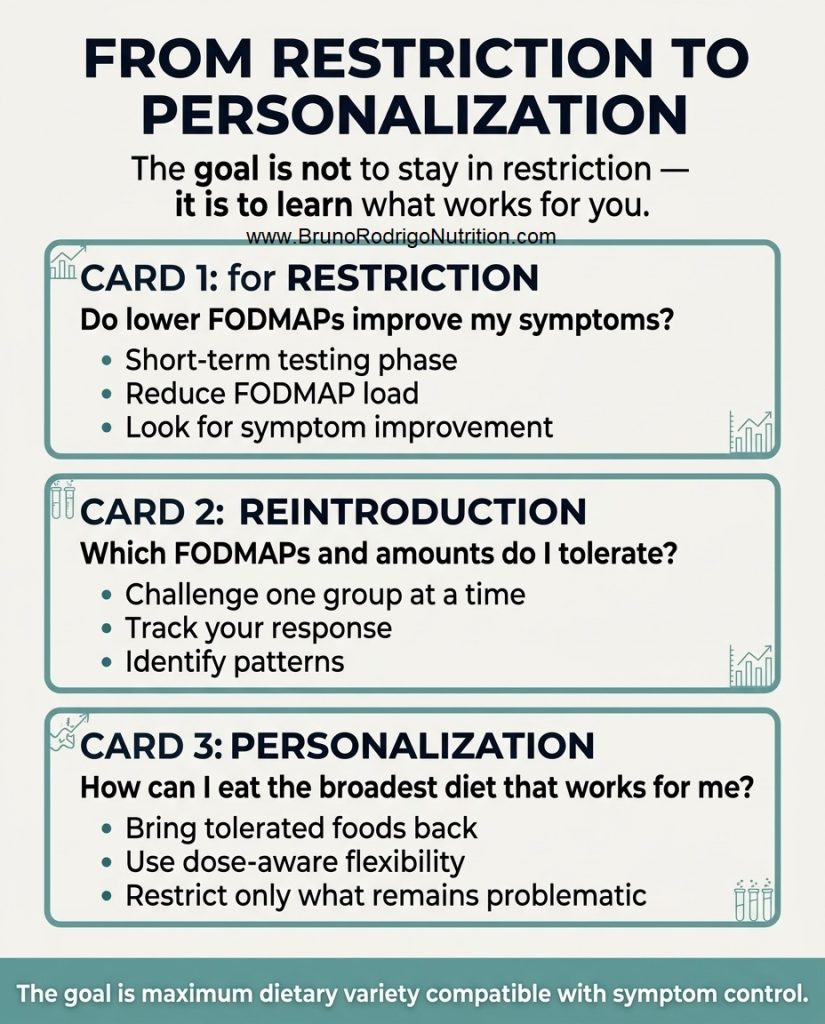
Restriction asks: “Do FODMAPs appear to matter?”
Reintroduction asks: “Which FODMAPs matter, and how much can I tolerate?”
This distinction matters because the goal is not to create a permanent list of “safe” and “unsafe” foods. It is to learn which fermentable carbohydrates are relevant to your symptoms, at which amounts, so the long-term diet can become less restrictive.
When to Start the Low FODMAP Reintroduction Phase
Symptoms should first be reasonably controlled
Reintroduction is easiest to interpret when Step 1 has produced a clear, meaningful improvement and symptoms are reasonably stable. Monash recommends moving to Step 2 when symptoms improve during the initial low FODMAP phase.[2]
You do not need to wait for a completely symptom-free week. The practical goal is a stable enough baseline that a change during a challenge is easier to recognize.
Do not stay in restriction just because you feel better
Feeling better during Step 1 is a reason to move forward, not a reason to remain strictly low FODMAP indefinitely.
Restriction can tell you whether lowering FODMAP exposure appears to help. Reintroduction is what begins to separate the restrictions that may actually be necessary from those that may not be.
Step 1 tests whether reducing FODMAPs helps. Step 2 tests which restrictions are actually necessary.
What if your symptoms did not improve?
If symptoms did not meaningfully improve after an appropriately implemented Step 1, extending restriction or removing more foods is not automatically the best next step.
Monash notes that some people with IBS do not respond meaningfully to a low FODMAP approach and may need to consider other management strategies.[2]
In that situation, reassessing the diagnosis, how the diet was implemented and other contributors to symptoms is generally more useful than forcing a reintroduction protocol onto an intervention that did not help.
How to Reintroduce FODMAPs: A Step-by-Step Plan
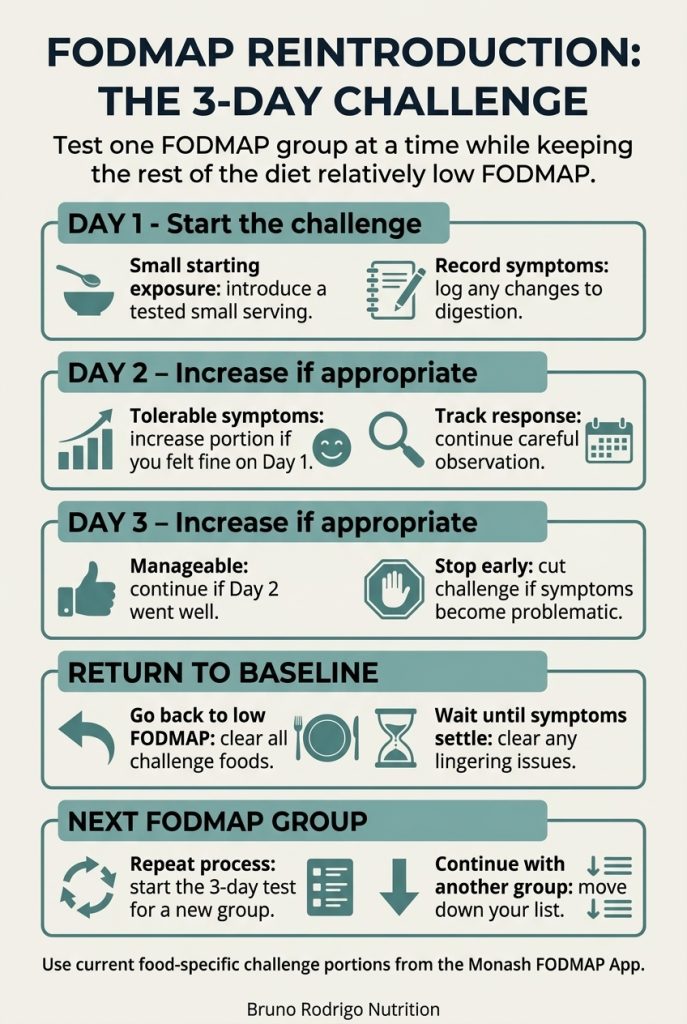
The basic principle is simple: keep most variables stable, challenge one FODMAP group at a time, record what happens, allow symptoms to settle, then repeat.
Current Monash guidance describes Step 2 as an approximately 8–12 week phase and uses three-day food challenges.[1]
Step 1 — Keep a Stable Low FODMAP Background Diet
During each challenge, keep the rest of your diet relatively low FODMAP and reasonably consistent.
This reduces background “noise” and makes it easier to connect a meaningful symptom change with the FODMAP being tested.
You do not need to make every meal identical. The goal is simply to avoid introducing several major dietary changes at the same time.
Step 2 — Choose One FODMAP Group
Monash currently separates reintroduction into the main FODMAP groups below.[1]
| FODMAP group | What you are testing |
|---|---|
| Fructose | Tolerance to excess fructose |
| Lactose | Tolerance to lactose |
| Sorbitol | Tolerance to sorbitol |
| Mannitol | Tolerance to mannitol |
| Fructans | Tolerance to fructans |
| GOS | Tolerance to galacto-oligosaccharides |
Fructans can require additional nuance because different fructan-containing foods may not always produce identical responses. The purpose of the process is to build a useful tolerance map, not to reduce every result to a single permanent label.
Step 3 — Choose a Suitable Challenge Food
A useful challenge food should give a relatively clear test of the FODMAP group you are trying to assess.
Current challenge foods and portions should be checked in the Monash FODMAP App rather than copied indefinitely from an old chart.
This matters because Monash updated its reintroduction feature in 2025 after laboratory retesting found meaningful differences in the FODMAP content of several foods. Some challenge foods and serving recommendations were revised.[4]
Check the current Monash FODMAP App before choosing a challenge food or serving progression.
Step 4 — Complete the 3-Day Challenge
Monash currently uses a three-day challenge. Exposure increases across the challenge according to the current food-specific protocol, provided symptoms remain tolerable.[3]
Day 1 → challenge
Day 2 → increase exposure if appropriate
Day 3 → increase exposure if appropriate
Avoid copying a generic progression such as “¼ cup → ½ cup → 1 cup” across foods. The appropriate quantities depend on the challenge food and current laboratory-tested guidance.
If significant symptoms develop, a challenge does not need to be pushed through simply to complete all three days.[10]
Step 5 — Record Symptoms
Track the symptoms that are relevant to you in a consistent way. Examples include:
- abdominal pain;
- bloating or distension;
- gas;
- bowel habits;
- urgency, when relevant;
- overall symptom response.
The goal is not perfect data collection. It is to create enough consistency to answer a practical question:
Did this challenge produce a meaningful change from my baseline?
Step 6 — Let Symptoms Return to Baseline
Do not begin the next challenge while you are still clearly reacting to the previous one.
Monash recommends a break of roughly 2–3 days between challenges, or until symptoms settle, while returning to the low FODMAP background diet.[3]
This reduces the chance that symptoms from one challenge spill into the next and make the result harder to interpret.
Step 7 — Repeat With the Other FODMAP Groups
Repeat the same structured process with the remaining FODMAP groups.
The full Step 2 process commonly takes around 8–12 weeks in Monash’s current three-step guidance, although the exact duration depends on the challenges completed and the time needed for symptoms to settle between them.[1]
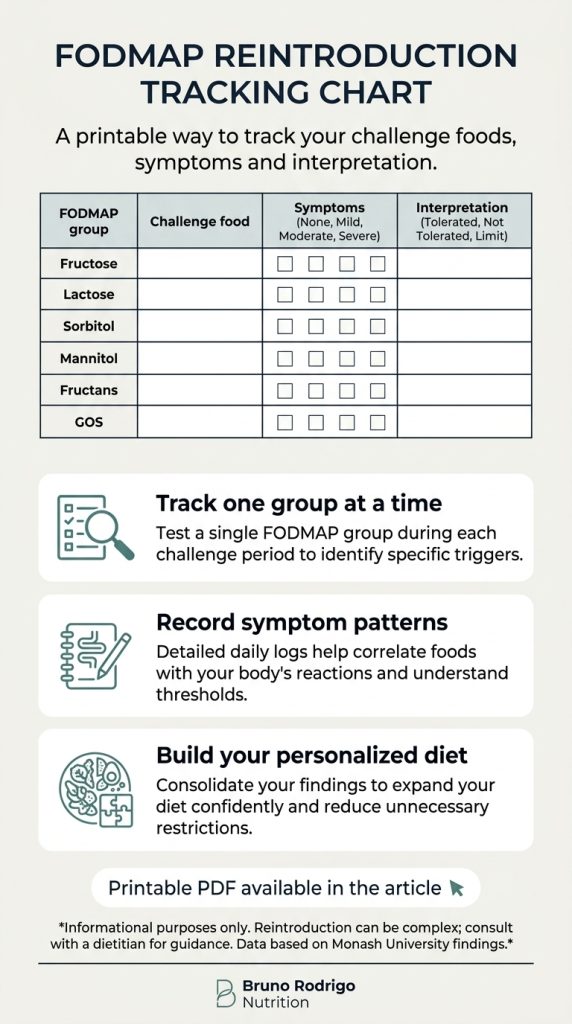
FODMAP Reintroduction Chart: How to Track Your Challenges
| FODMAP group | Challenge food* | Day 1 | Day 2 | Day 3 | Symptoms | Interpretation | Retest later? |
| Fructose | |||||||
| Lactose | |||||||
| Sorbitol | |||||||
| Mannitol | |||||||
| Fructans | |||||||
| GOS |
*Choose the current challenge food and serving progression using up-to-date Monash FODMAP App guidance or professional advice.
Why Static Food-and-Dose Charts Can Become Outdated
A FODMAP reintroduction chart that lists fixed challenge foods and serving sizes can become outdated as foods are retested.
In April 2025, Monash University updated the Reintroduction feature in its FODMAP App after laboratory retesting found meaningful differences in the FODMAP content of several foods. Some foods had changed enough that they were no longer suitable for the same reintroduction challenge, and serving recommendations were revised.[4]
This does not mean earlier laboratory tests were necessarily “wrong.” Agricultural foods naturally vary according to factors such as variety, growing conditions, geography and individual batches.
For that reason, this guide explains how to run and interpret reintroduction, while current challenge foods and serving amounts should be checked using up-to-date laboratory-tested data.
A static chart should organize your results — not pretend to be a permanent laboratory database.
Which FODMAP Should You Reintroduce First?
There is no single correct order for FODMAP reintroduction.
Monash University specifically states that the FODMAP groups do not need to be challenged in a universal sequence. The best place to start depends on your goals, usual diet and confidence with the process.[5]
You might start with a FODMAP you expect to tolerate well, which can make the process feel less intimidating. Another option is to test a suspected trigger first if getting a clear answer would be particularly useful. Or you may prioritize a FODMAP found in a food you eat frequently and would like to bring back into your usual diet.
What matters more than the order is testing one FODMAP group at a time while keeping the rest of the diet reasonably stable.
A practical question is therefore not:
“Which FODMAP should everyone test first?”
but:
“Which result would be most useful for my diet right now?”
How to Interpret a FODMAP Challenge
The result of a FODMAP challenge is not simply pass or fail. What matters is how symptoms change as exposure increases and what that tells you about your practical tolerance.
Current Monash guidance provides a useful framework for interpreting three-day challenges and translating those results into the personalization phase.[6]
No Meaningful Symptoms
If you complete the challenge without meaningful symptoms, that suggests good tolerance to that FODMAP within the amounts tested.
In the personalization phase, this usually supports bringing foods containing that FODMAP back into the diet rather than continuing to restrict them unnecessarily.
It does not mean that every food or every possible serving size will always be symptom-free, but it is useful practical evidence that broad restriction of that FODMAP may not be necessary.
Mild or Dose-Dependent Symptoms
If symptoms appear only when the portion becomes larger, the most useful conclusion may be that your tolerance is dose-dependent.
That can be more valuable than a simple “yes/no” result. You may tolerate smaller or moderate servings well while developing symptoms only above a certain threshold.
Monash’s current personalization guidance reflects this idea: people with mild-to-moderate responses may be able to include lower and moderate servings while limiting larger amounts.[6]
Tolerance is often a threshold, not a switch.
Clear or Severe Symptom Response
A clear symptom response suggests that larger amounts of that FODMAP may currently be poorly tolerated.
That information can guide the personalization phase, but it still does not necessarily mean removing every food containing that FODMAP permanently.
Current Monash guidance supports keeping tolerated lower servings where possible and reconsidering tolerance over time because individual thresholds can change.[6]
A Reaction Does Not Always Mean “Never Eat This Again”
A symptom flare during reintroduction is useful information, but it should be interpreted in context rather than automatically becoming a lifelong food ban.
A blinded randomized reintroduction study published in Gastroenterology enrolled 117 people with IBS. Among responders who completed reintroduction, symptom recurrence showed a highly individualized pattern, with an average of about 2.5 FODMAP triggers per participant. Fructans and mannitol were the most frequent triggers. Interestingly, the glucose control also met the study’s symptom-recurrence criterion in 26% of corresponding challenges.[7]
That does not mean FODMAP reactions are imaginary. It shows why gastrointestinal symptoms cannot always be interpreted from one experience in isolation.
IBS symptoms naturally fluctuate, and expectations, background symptoms and other factors can influence what happens during a challenge.
Reintroduction therefore works best as a structured pattern-finding process, not as a collection of single food verdicts.
Tolerance itself is also not necessarily fixed forever. Monash currently recommends reconsidering tolerance over time when appropriate.[6]
A challenge result describes your current tolerance. It does not give a food a permanent label.
Why Reintroduction Matters
Reintroduction is not an optional extra after the “real” low FODMAP diet. It is the step that turns temporary restriction into useful information.
Without reintroduction, someone who feels better during Step 1 may conclude that every food removed during restriction must remain excluded. In reality, individual responses vary considerably.[7]
More Food Variety
Foods that are tolerated can return to the diet, reducing the number of unnecessary restrictions.
The objective is not to finish the process with the shortest possible food list, but with the broadest diet compatible with acceptable symptom control.
Better Nutritional Flexibility
Reintroducing tolerated foods makes it easier to obtain fiber, micronutrients and dietary variety from a wider range of foods.
It can also make eating socially and practically easier than maintaining a highly restrictive Step 1 diet indefinitely.
Less Unnecessary Restriction
Long-term observational data support this direction.
In a seven-year follow-up after dietitian-delivered low FODMAP education, 62% of participants reported following a personalized diet, while only 12% remained on strict FODMAP restriction. Food-related quality of life was lower among those continuing strict restriction.[8]
A separate real-world evaluation of 184 patients also found that completing FODMAP reintroduction according to the dietetic protocol was associated with better long-term symptom outcomes, although the observational design cannot establish causality.[9]
Greater Confidence Around Food
Reintroduction can replace uncertainty with information.
Instead of asking:
“Is this food safe?”
the person can begin asking:
“How much of this FODMAP do I usually tolerate?”
That is a much more flexible foundation for long-term eating.
From Reintroduction to Personalization
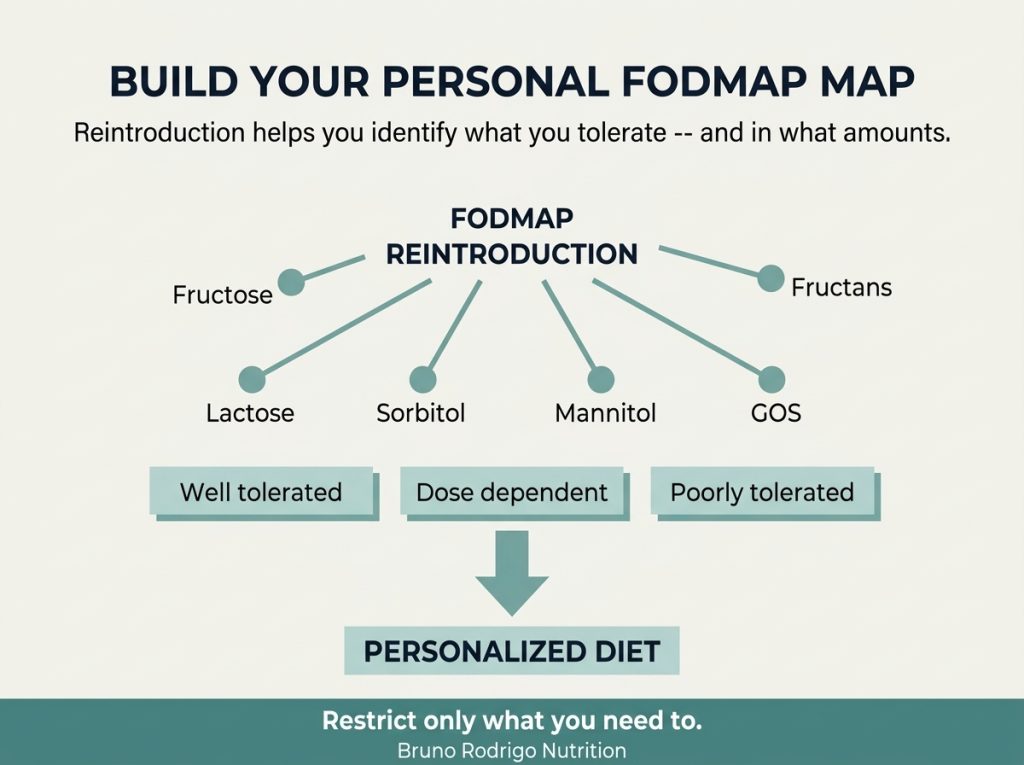
Reintroduction gives you data. Personalization turns those data into a sustainable diet.
Once the main challenges have been completed, the goal is to translate the results into everyday eating rather than returning to strict Step 1 restriction.
A simple framework is:
| Reintroduction result | Long-term implication |
| Well tolerated | Bring the FODMAP back into the diet |
| Tolerated at smaller/moderate amounts | Use the amount that fits your individual threshold |
| Poorly tolerated at larger amounts | Limit the problematic exposure rather than automatically excluding every related food |
| Unclear result | Consider repeating the challenge when symptoms are stable |
Monash’s current interpretation guidance follows the same general principle: no reaction supports greater liberalization; mild or moderate reactions may still allow smaller or moderate amounts; stronger reactions may justify limiting larger exposures while preserving tolerated portions when possible.[6]
There can also be additional nuance within FODMAP categories. For example, fructan tolerance may differ across food sources, so a broad label such as “fructan intolerant” may sometimes be less useful than a more detailed pattern.[6]
The goal is not to finish reintroduction with a longer list of foods to avoid. It is to finish with a clearer map of what you can eat.
Common FODMAP Reintroduction Mistakes
Starting Before Symptoms Are Reasonably Stable
If symptoms are already fluctuating substantially, it becomes much harder to tell whether a challenge actually changed anything.
Monash recommends beginning individual challenges when symptoms are reasonably well controlled.[3]
Testing Several FODMAPs at Once
If multiple FODMAP groups change simultaneously, the result becomes difficult to interpret.
Challenge one group at a time whenever possible.
Using a Poor Challenge Food
A useful challenge food should primarily test the FODMAP group you are trying to assess.
Mixed-FODMAP foods can create ambiguity and make it harder to know which fermentable carbohydrate caused the response.
Copying an Old Challenge Chart
Foods are retested.
A challenge food that was appropriate several years ago may no longer contain the FODMAP profile or dose expected from older data. Monash revised its reintroduction foods and serving sizes in 2025 for exactly this reason.[4]
Changing the Rest of Your Diet at the Same Time
Reintroduction works best when the background diet remains relatively stable and low FODMAP, reducing competing explanations for symptom changes.[10]
Pushing Through Significant Symptoms Just to Complete Three Days
The three-day structure is a tool, not a requirement to ignore unpleasant symptoms.
Monash guidance notes that a challenge can be stopped when significant symptoms develop, with the result interpreted accordingly.[10]
Treating Mild Gas or Bloating as Automatic Failure
Some gastrointestinal gas and distension are normal physiological responses to fermentation.
The clinically useful question is whether the response is meaningful enough to affect comfort or daily life, not whether absolutely no sensation occurs.
Starting the Next Challenge Before Symptoms Settle
Monash recommends allowing symptoms to return to baseline between challenges, often with a few low-FODMAP background days.[3]
Testing Foods Instead of Learning About FODMAP Groups
The food is the testing vehicle.
The larger goal is to understand tolerance to the fermentable carbohydrate involved — and, when relevant, whether tolerance depends on dose or food source.
Never Converting the Results Into a Personalized Diet
Collecting challenge results without liberalizing tolerated foods defeats much of the purpose of Step 2.
Reintroduction should lead somewhere: toward a broader, more flexible long-term diet.
When to Get Professional Help
Many people understand the basic logic of reintroduction easily. The difficult part is often interpreting inconsistent symptoms without making the diet progressively more restrictive.
Professional guidance becomes particularly useful when:
- symptoms remain unstable between challenges;
- several different FODMAP groups appear to trigger symptoms;
- challenge results are inconsistent or difficult to interpret;
- your diet has already become very restricted;
- you are afraid to reintroduce foods despite good symptom control;
- nutritional adequacy or unintentional weight loss is a concern;
- other gastrointestinal conditions may be contributing to symptoms;
- or you have not received an appropriate assessment for persistent gastrointestinal symptoms.
Monash recommends working with a dietitian experienced in the FODMAP approach, particularly for selecting challenge foods and doses and interpreting reintroduction results.[11]
The purpose of professional guidance should not be to identify the maximum number of foods you can avoid.
It should be to obtain clearer information with the minimum necessary restriction.
Frequently Asked Questions
How long does FODMAP reintroduction take?
Monash University currently describes the reintroduction phase as approximately 8–12 weeks, although the exact duration varies according to the challenges completed and symptom recovery between them.[1]
How many days should a FODMAP challenge last?
Monash currently uses three-day challenges, with one suitable challenge food consumed daily according to the current food-specific protocol.[1]
Which FODMAP should I reintroduce first?
There is no mandatory universal order. The first challenge can be selected according to confidence, suspected tolerance or the practical importance of that FODMAP in your usual diet.[5]
Should I stay low FODMAP during reintroduction?
Generally, yes. During Step 2, the background diet remains relatively low FODMAP while one FODMAP group is challenged at a time, helping make symptom responses easier to interpret.[1]
What if I get symptoms during a challenge?
Record what happened and allow symptoms to settle before moving to the next challenge. A reaction helps define your tolerance at the tested dose, but it should not automatically be interpreted as a permanent ban on every food containing that FODMAP.
Do I need to reintroduce every food separately?
No. The purpose is primarily to test FODMAP groups and tolerance levels, not every individual food you previously removed.
Can FODMAP tolerance change over time?
Yes. Monash notes that individual tolerance may change, which is why foods that were poorly tolerated can sometimes be reconsidered later. Food testing itself can also change as products and agricultural samples are retested.[4][6]
References
- Monash University. The 3-Step FODMAP Diet. https://www.monashfodmap.com/documents/5/3-step_FODMAP_Diet.pdf
- Monash University. Starting the Low FODMAP Diet. https://www.monashfodmap.com/ibs-central/i-have-ibs/starting-the-low-fodmap-diet/
- Monash University. Practical Tips for FODMAP Reintroduction. https://www.monashfodmap.com/blog/practical-tips-fodmap-reintroduction/
- Monash FODMAP. Reintroduction Update. April 28, 2025. https://monashfodmap.com/blog/reintroduction-update/
- Monash FODMAP. Order of FODMAP Reintroduction. May 8, 2025. https://monashfodmap.com/blog/order-of-fodmap-reintroduction/
- Monash FODMAP. Interpreting Reintroduction Challenges and Using the Filters in the Monash FODMAP App. February 27, 2026. https://monashfodmap.com/blog/interpreting-reintroduction-challenges/
- Van den Houte K, et al. Efficacy and Findings of a Blinded Randomized Reintroduction Phase for the Low FODMAP Diet in Irritable Bowel Syndrome. Gastroenterology. 2024;167(2):333–342. https://pubmed.ncbi.nlm.nih.gov/38401741/
- Silva H, et al. Dietary Intake, Symptom Control and Quality of Life After Dietitian-Delivered Education on a FODMAP Diet for Irritable Bowel Syndrome: A 7-Year Follow Up. Neurogastroenterology & Motility. 2025;37(12):e70116. https://pubmed.ncbi.nlm.nih.gov/40589416/
- Foulkes R, et al. A Service Evaluation of FODMAP Restriction, FODMAP Reintroduction and Long-Term Follow-Up in the Dietary Management of Irritable Bowel Syndrome. Journal of Human Nutrition and Dietetics. 2025;38(1):e13393. https://pubmed.ncbi.nlm.nih.gov/39498596/
- Monash University. Reintroduction Using the Diary Function. https://www.monashfodmap.com/blog/reintroduction-using-diary-function/
- Monash University. Frequently Asked Questions — FODMAP and IBS. https://monashfodmap.com/about-fodmap-and-ibs/frequently-asked-questions/