
The low FODMAP diet is a temporary dietary strategy used mainly to manage symptoms of irritable bowel syndrome (IBS). It reduces certain fermentable carbohydrates for a short period, then systematically reintroduces them to identify individual triggers and tolerances.
The diet has three phases: restriction, reintroduction and personalization. The restrictive phase usually lasts only a few weeks — Monash University recommends about 2–6 weeks — and is not intended to become a permanent way of eating.
Research supports the low FODMAP diet as one of the best-studied dietary interventions for IBS, but it does not work for everyone and unnecessary long-term restriction may reduce diet variety.
Key Takeaways
- The strongest evidence for the low FODMAP diet is for IBS.
- It is a 3-phase process, not a permanent elimination diet.
- Restriction is temporary and is followed by reintroduction.
- Food classification often depends on serving size.
- The goal is the least restrictive personalized diet that controls symptoms.
- Not everyone with digestive symptoms should start a low FODMAP diet.
- Current laboratory-tested food information should be checked using resources such as the Monash FODMAP App.
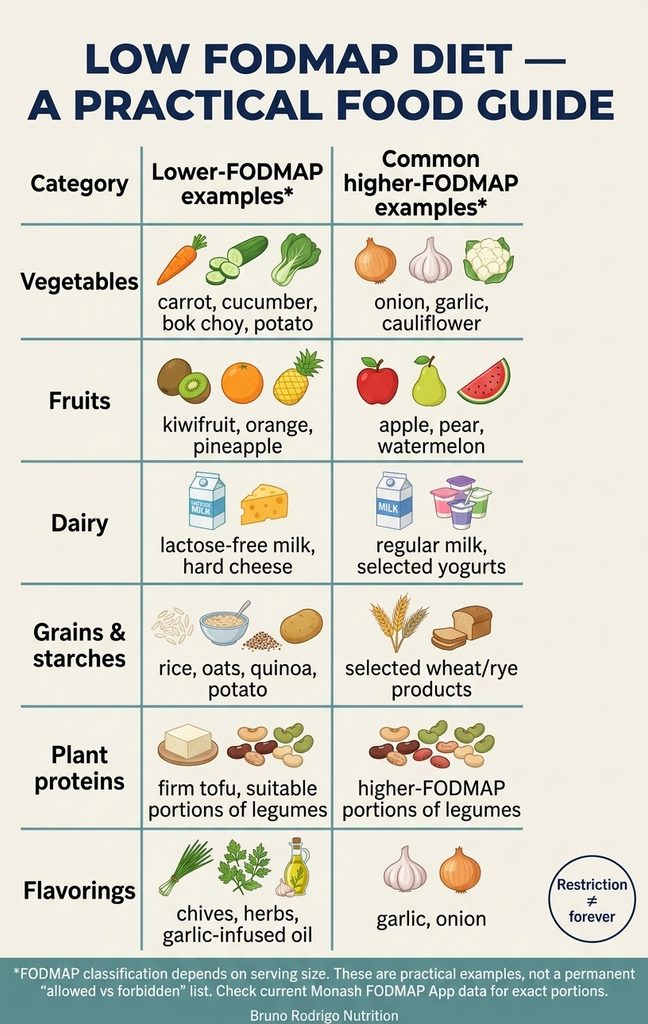
What Is the Low FODMAP Diet?
The low FODMAP diet is a structured dietary approach designed primarily to reduce gastrointestinal symptoms in people with irritable bowel syndrome (IBS).
FODMAPs are short-chain carbohydrates that are either poorly absorbed or not fully digested in the small intestine. They can draw water into the intestine and are then fermented by gut bacteria, producing gas. These processes occur to some extent in everyone, but people with IBS may be more sensitive to the resulting intestinal distension, contributing to symptoms such as bloating, abdominal pain, excess gas and altered bowel habits. [1]
Importantly, the low FODMAP diet is not based on the idea that FODMAP-containing foods are unhealthy. Many high-FODMAP foods are nutritious. The strategy temporarily reduces selected fermentable carbohydrates to test whether symptoms improve, then systematically reintroduces them to identify individual tolerance.
What does FODMAP stand for?
FODMAP stands for:
- Fermentable
- Oligosaccharides — mainly fructans and galacto-oligosaccharides (GOS)
- Disaccharides — mainly lactose
- Monosaccharides — mainly excess fructose
- And
- Polyols — including sorbitol and mannitol
These carbohydrates occur naturally in a wide range of foods, including fruits, vegetables, grains, legumes and dairy products, as well as in some food additives and sweeteners. [2]
Why can FODMAPs trigger symptoms?
FODMAPs can increase the amount of water and gas inside the intestine. In someone with visceral hypersensitivity — a common feature of IBS — the stretching created by this additional fluid and gas can be experienced as pain, pressure, bloating or urgency.
This distinction matters: FODMAPs do not cause IBS, and most people can eat high-FODMAP foods without difficulty. The same physiological fermentation can produce very different symptoms depending on intestinal sensitivity, motility and individual tolerance. [1]
That is also why the goal of the diet is not to permanently remove every fermentable carbohydrate. It is to discover which FODMAPs — and which amounts — matter for the individual.
Who Is the Low FODMAP Diet For?
The strongest evidence is for IBS
The strongest evidence for the low FODMAP diet is in people with diagnosed irritable bowel syndrome.
The American Gastroenterological Association describes it as the dietary intervention with the strongest evidence base for IBS, while emphasizing that it should be used as a time-limited process consisting of restriction, reintroduction and personalization. [3]
It may be particularly reasonable to consider when symptoms such as abdominal pain, bloating, gas or altered bowel habits appear to be related to meals.
However, IBS is not diagnosed simply because someone feels bloated after eating. Persistent gastrointestinal symptoms should be assessed in context rather than assuming that FODMAPs are automatically the cause.
What about bloating without IBS?
Bloating is one of the symptoms that often improves during a low FODMAP intervention in people with IBS. A recent network meta-analysis found improvement in abdominal bloating or distension compared with a habitual diet. [4]
But bloating alone is not a diagnosis.
Constipation, lactose intolerance, celiac disease, disorders of gut-brain interaction, altered motility and other gastrointestinal conditions can all contribute to bloating. For that reason, a low FODMAP diet should not be presented as a universal “anti-bloating diet.”
A more accurate approach is:
If bloating is persistent or significant, identify the clinical context first. Then decide whether a structured low FODMAP trial is appropriate.
This distinction lets us target the low fodmap diet for bloating query without making the bad SEO-medical shortcut:
bloating = low FODMAP.
What about SIBO?
Small intestinal bacterial overgrowth — SIBO — is a different condition from IBS, although symptoms can overlap and some people may have both.
A low FODMAP diet may reduce fermentable substrate and help control gastrointestinal symptoms in some people with SIBO, but the evidence is substantially less established than it is for IBS. Current reviews describe dietary strategies as a possible component of management rather than evidence that low FODMAP restriction by itself reliably eliminates bacterial overgrowth. [5]
Therefore, I would not describe the low FODMAP diet as a primary treatment or cure for SIBO.
If SIBO is suspected or diagnosed, the underlying cause, diagnostic uncertainty and appropriate medical treatment also need to be considered.
This gives us a scientifically defensible answer to a query that is full of overclaims online.
Who should be cautious with a restrictive low FODMAP diet?
A restrictive diet is not appropriate for everyone.
The AGA identifies poor candidates for restrictive dietary interventions as people at risk of malnutrition, people with limited food access, people already eating very few potential trigger foods, and those with an eating disorder or uncontrolled psychiatric disorder. Screening for disordered eating is particularly important before starting a restrictive diet. [3]
Professional guidance becomes particularly valuable when the diet is already limited, nutritional adequacy is uncertain, symptoms are severe or the person is becoming increasingly afraid of eating.
Does the Low FODMAP Diet Work?
Yes, the low FODMAP diet can improve IBS symptoms in many people — but it does not work for everyone, and the strongest evidence relates to short-term symptom management.
A 2026 umbrella review pooled evidence from 16 meta-analyses involving 141 studies and 9,904 people with IBS. Overall, low FODMAP interventions reduced IBS symptom severity and improved quality of life. However, statistically significant benefits were not demonstrated for every individual outcome, including abdominal pain, stool consistency and stool frequency, and the authors highlighted methodological limitations inherent to dietary trials. [6]
A 2025 systematic review and network meta-analysis similarly concluded that the largest amount of evidence among dietary interventions for IBS currently exists for the low FODMAP diet, while noting that certainty for many comparisons remains low or very low. [4]
A large 2024 randomized trial — CARIBS — compared a low-FODMAP diet combined with traditional IBS dietary advice, a low-carbohydrate diet and optimized medical therapy. After four weeks, 76% of participants in the low-FODMAP-plus-traditional-advice group met the study’s symptom-response criterion, compared with 58% receiving optimized medical therapy. This was a single-center trial and the intervention combined low FODMAP with traditional dietary advice, so it should not be interpreted as proof that low FODMAP is universally superior to medication. [7]
What the evidence actually tells us
| Evidence source | What it tells us | Important limitation |
|---|---|---|
| Clinical guidelines | Low FODMAP is a recognized dietary option for IBS | It should be a time-limited trial, not permanent restriction |
| Randomized trials | Clinically meaningful symptom improvement is possible | Response varies between individuals |
| Meta-analyses | Overall IBS symptom severity tends to improve | Certainty varies by outcome and comparator |
| Bloating studies | Bloating/distension may improve, particularly within IBS | Bloating has many causes outside IBS |
| Long-term evidence | Personalized diets can remain effective after reintroduction | Evidence is less extensive than for initial restriction |
| Reintroduction studies | People respond differently to individual FODMAP groups | There is no single universal trigger profile |
The practical conclusion is therefore not:
“Low FODMAP works.”
It is:
“Low FODMAP is one of the best-studied dietary strategies for IBS, but response is individual and should be evaluated rather than assumed.”
How the Low FODMAP Diet Works: The 3 Phases
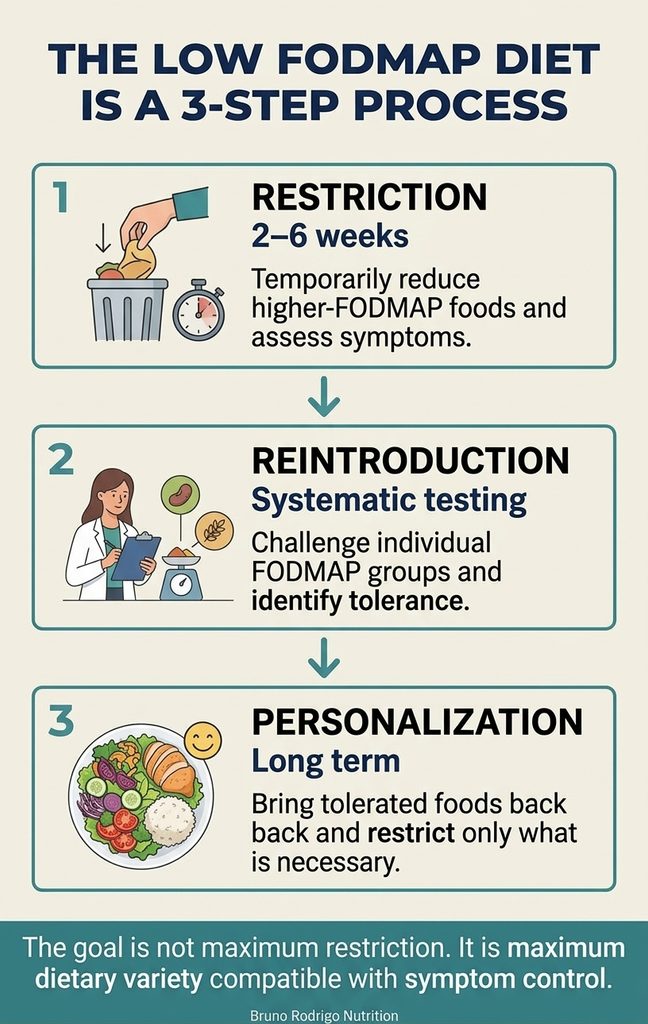
One of the most common misunderstandings about the low FODMAP diet is treating the restrictive phase as the entire diet.
It is actually a three-step process:
Restriction → Reintroduction → Personalization
Monash University describes Step 1 as approximately 2–6 weeks, Step 2 as roughly 8–12 weeks, and Step 3 as the long-term personalized diet. The AGA similarly advises that the restrictive phase should last no longer than about 4–6 weeks. [8]
Phase 1 — Restriction
During the first phase, higher-FODMAP foods are swapped for lower-FODMAP alternatives.
The aim is not to eliminate every molecule of every FODMAP. It is to reduce overall exposure enough to determine whether symptoms improve.
Monash recommends using this phase for approximately 2–6 weeks. [8]
If symptoms improve meaningfully, that creates a reason to move forward.
If they do not, extending restriction indefinitely is generally not the logical next step.
Phase 2 — Reintroduction
Reintroduction is where the diet begins to answer the more important question:
Which FODMAPs actually matter for me?
The background diet remains relatively low FODMAP while individual FODMAP groups are systematically challenged.
Monash’s current 3-step guidance describes an 8–12 week reintroduction phase and separates challenges for fructose, lactose, sorbitol, mannitol, fructans and GOS. [8]
Responses differ substantially between individuals, which is exactly why staying permanently in Step 1 throws away some of the most useful information the diet can provide.
Read More: FODMAP Reintroduction: How to Personalize Your Diet After the Elimination Phase
Phase 3 — Personalization
The third phase is the long-term diet.
Foods and FODMAP groups that are well tolerated are brought back. Foods that consistently trigger symptoms may be limited by type, portion or frequency, depending on individual tolerance.
Monash explicitly describes personalization as the long-term goal and continues to update its tools to help users tailor food guidance based on reintroduction results. [9]
The goal is not maximum restriction. It is maximum dietary variety compatible with symptom control.
That is the idea I would visually highlight in the article.
Low FODMAP Diet Plan: How to Start
Step 1 — Confirm that a low FODMAP approach makes sense
Before restricting foods, consider the symptom pattern and clinical context.
The strongest indication is IBS. Persistent or unexplained gastrointestinal symptoms should not simply be self-diagnosed as “FODMAP intolerance.”
If there are warning signs or significant diagnostic uncertainty, investigation comes before restriction.
Step 2 — Define a short testing period
Do not begin with:
“I’m going low FODMAP from now on.”
Begin with:
“I am testing whether reducing FODMAPs improves my symptoms.”
Set a review point within the recommended short restriction window.
Monash uses approximately 2–6 weeks; AGA guidance says the restriction phase should last no more than about 4–6 weeks. [8]
Step 3 — Identify your main high-FODMAP exposures
You usually do not need to rebuild your entire diet.
Start by identifying where the largest FODMAP exposures are coming from:
onion and garlic, certain fruits, lactose-containing foods, wheat-based foods, legumes, selected vegetables, polyol sweeteners or combinations of these.
The goal is targeted substitution, not removing as much food as possible.
Step 4 — Build meals from foods you already eat
The easiest low FODMAP diet plan is usually the one that still resembles your normal diet.
Instead of designing a completely foreign menu, keep familiar meal structures and replace the ingredients that contribute the most FODMAPs.
That improves practicality and makes it easier to understand whether FODMAP reduction — rather than an entirely different eating pattern — actually influenced symptoms.
Step 5 — Check portions, not just food names
A food may have:
a low-FODMAP serving
and
a higher-FODMAP serving
at the same time.
That is not contradictory.
The classification is serving-size specific.
Use current laboratory-tested data such as the Monash University FODMAP Diet App rather than treating old food lists as permanent rules. Monash continues to retest foods and update its database. [10]
Step 6 — Track symptoms without turning food into a full-time project
Track enough information to identify a meaningful change:
- abdominal pain;
- bloating/distension;
- bowel pattern;
- urgency if relevant;
- overall symptom severity.
You do not need to calculate every gram of FODMAP in every meal.
The purpose of tracking is to answer:
“Am I meaningfully better during this intervention?”
not:
“Can I collect the maximum possible amount of food data?”
Step 7 — Decide in advance what happens next
Before beginning restriction, set a review point.
If symptoms improve meaningfully:
move to reintroduction.
If they do not:
reassess rather than automatically restricting more foods.
That one decision helps prevent a two-week experiment from silently turning into a two-year elimination diet.
Building a Low FODMAP Meal
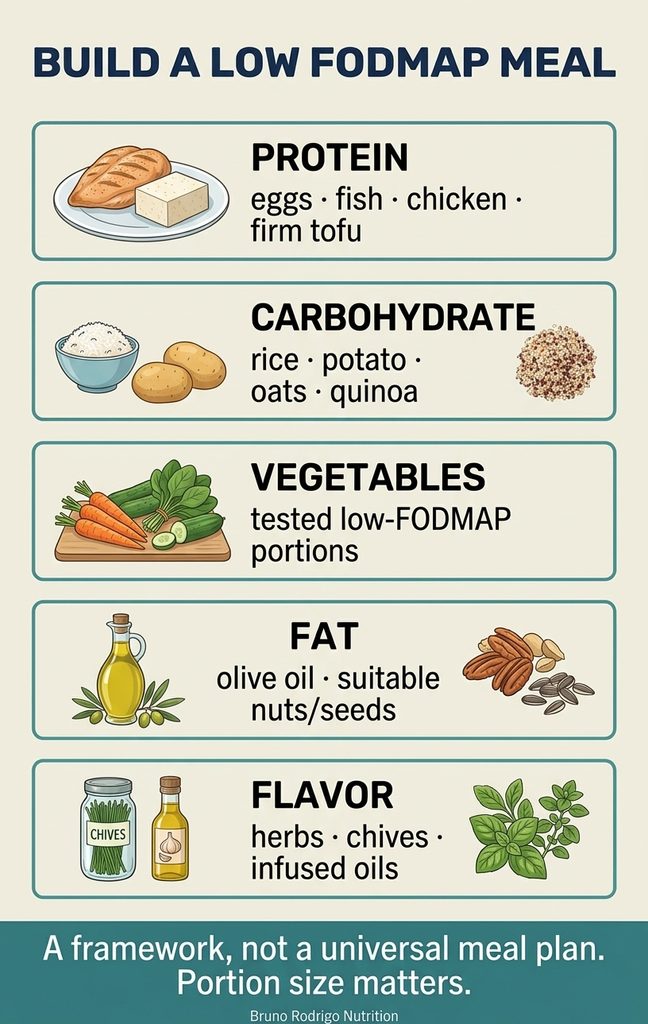
A useful meal framework is more practical than a rigid seven-day menu.
| Meal component | Examples that can fit a low FODMAP meal |
|---|---|
| Protein | Eggs, plain fish, chicken, lean meat, firm tofu |
| Carbohydrate | Rice, potato, oats, quinoa |
| Vegetable | Choose from current tested portions — see Low FODMAP Vegetables |
| Fruit | Current tested low-FODMAP fruit servings |
| Calcium-rich food | Lactose-free dairy or appropriate low-lactose alternatives |
| Fat | Olive oil, suitable nuts and seeds |
| Flavor | Herbs, chives, green onion tops, garlic-infused oil |
Plain meat, fish and eggs contain little or no carbohydrate and therefore are not significant natural FODMAP sources, but marinades, sauces, onion, garlic and other added ingredients can change the final meal.
Food-specific low FODMAP status depends on serving size. Check current Monash FODMAP App data when portions matter.
What Foods Are High and Low FODMAP?
FODMAP is not one substance. Different foods contain different fermentable carbohydrates.
This table provides examples, not a definitive food list.
| FODMAP type | Common higher-FODMAP sources | Lower-FODMAP alternatives/examples |
|---|---|---|
| Fructans | Garlic, onion, leek, many wheat/rye foods | Chives, green onion tops, garlic-infused oil, rice or quinoa-based staples |
| GOS | Many legumes/pulses, cashews, pistachios | Firm tofu, peanuts, macadamias; some legumes at tested portions |
| Lactose | Regular milk, many yogurts, some soft dairy foods | Lactose-free milk, suitable lactose-free yogurt, many hard cheeses |
| Excess fructose | Honey, apples, pears, mango | Kiwifruit, oranges, pineapple and other tested alternatives |
| Sorbitol | Selected fruits including some stone fruits | Fruit choices with lower tested sorbitol loads |
| Mannitol | Some mushrooms and vegetables | Carrot, potato, eggplant and appropriate tested alternatives |
Monash emphasizes that the FODMAP content of individual foods and portions should be checked using current data rather than relying on a simplified static list. [2]
Looking specifically for vegetables? → Read: Low FODMAP Vegetables: What to Eat, Portions, Swaps and Common Mistakes.
Why Portion Size Matters
One of the most useful concepts in the low FODMAP diet is also one of the most frequently missed:
A food’s FODMAP rating is serving-size specific.
A food does not necessarily have one permanent classification.
A practical way to think about it is:
food + serving size = current FODMAP rating
The Monash App therefore gives traffic-light ratings at different amounts. Its “green” thresholds are also deliberately conservative so that people can generally combine more than one low-FODMAP serving within a mixed meal. [11]
This is why “safe food” and “forbidden food” are often poor ways to describe the diet.
A better question is:
How much of this food is currently considered low FODMAP, and how much do I personally tolerate?
Why FODMAP Food Lists Can Change
Two reputable FODMAP resources can sometimes appear to disagree.
That does not necessarily mean one is wrong.
FODMAP content can vary because of:
- serving size;
- plant variety or cultivar;
- growing conditions;
- geographical origin;
- food processing;
- different batches;
- laboratory retesting;
- older sources continuing to circulate online.
Monash’s laboratory team has explicitly reported meaningful differences when foods are retested and updated its reintroduction recommendations based on newer results. The researchers note that variation in agricultural foods is expected and does not mean earlier tests were fraudulent or useless — they reflected the samples tested at that time. [10]
That gives us the sentence I manteria em box:
Serving sizes and classifications may change as foods are retested. Use this guide for practical orientation and consult the current Monash FODMAP App for the latest laboratory-tested serving information.
Common Low FODMAP Diet Mistakes
Staying in restriction for too long
Step 1 is temporary. If symptoms improve, the next step is reintroduction — not indefinite restriction. [12]
Treating high-FODMAP foods as unhealthy
High-FODMAP foods are not inherently unhealthy. Many are nutrient-dense foods that may be perfectly well tolerated in personalization.
Confusing gluten with FODMAPs
Gluten is a protein. FODMAPs are carbohydrates. Wheat may create confusion because it contains both gluten and fructans, but gluten-free and low FODMAP are not interchangeable concepts.
Using an old static food list
Laboratory results can change as foods are retested. Static PDFs and old blog charts should not override current tested data. [10]
Ignoring serving size
Low FODMAP does not automatically mean unlimited.
Removing foods instead of replacing them
Restriction without appropriate substitutions can reduce variety and nutritional adequacy. The practical strategy should usually be swap, not simply remove.
Starting without a reintroduction plan
If there is no defined path out of restriction, Step 1 can easily become the permanent diet.
Assuming every digestive symptom is caused by FODMAPs
Food is only one part of gastrointestinal symptom management. Constipation, motility, visceral hypersensitivity, stress, other dietary factors and medical conditions may also matter.
Micromanaging FODMAP stacking unnecessarily
FODMAP loads can add up in a meal, but Monash intentionally uses conservative green thresholds. If symptoms are already well controlled, there is no reason to turn each meal into a complex FODMAP calculation. [11]
Risks and Limitations of the Low FODMAP Diet
The low FODMAP diet is evidence-based, but that does not make it risk-free or appropriate for indefinite self-directed restriction.
Nutritional adequacy
Highly restrictive implementation can reduce dietary variety.
Studies summarized in the 2025 Seoul IBS consensus reported lower intake of some nutrients, including calcium, iron and magnesium, in some low FODMAP interventions. [13]
This is one reason the personalization phase matters.
Fiber and food variety
Removing whole categories of fruits, vegetables, grains and legumes without thoughtful substitutions can unintentionally reduce fiber intake and diet quality.
The appropriate response is not necessarily supplementation or even more restriction — it is often better food substitution and broader reintroduction.
Gut microbiota
Some studies of the restrictive phase have reported lower abundance of Bifidobacteria during low FODMAP intake. The long-term clinical significance remains uncertain, particularly because most trials have focused on the restriction phase rather than the full restriction → reintroduction → personalization process. [13]
So I would not write:
“Low FODMAP damages your microbiome.”
I would write:
Short-term FODMAP restriction can change the gut microbiota, which is another reason unnecessary long-term restriction should be avoided.
Food-related anxiety and disordered eating
Restrictive diets can be particularly problematic for someone with an eating disorder or significant food-related anxiety.
AGA guidance recommends screening for disordered eating before restrictive dietary interventions, and a 2024 Lancet Gastroenterology & Hepatology review highlights eating-disorder risk, food cost, complexity and food-related quality of life as important considerations when using whole-diet interventions for IBS. [3]
Complexity and cost
Following a low FODMAP diet can require label reading, meal planning, recipe modification and access to alternative foods.
A strategy that works biologically but cannot be implemented realistically is not a good long-term nutrition strategy.
The evidence is stronger for the initial phase than for long-term restriction
Most randomized trials have studied the restrictive phase.
That means we know substantially more about short-term symptom response than we do about remaining highly restricted for long periods — which is another reason not to confuse the intervention phase with the long-term diet. [13]
What If the Low FODMAP Diet Does Not Work?
Not responding to a properly implemented low FODMAP trial is useful information.
It suggests that continuing to eliminate more foods may not be the best strategy.
The AGA recommends trying dietary interventions for a predefined period and moving to another treatment approach if there is no clinical response. [3]
Possible next questions include:
- Was IBS the correct working diagnosis?
- Was the diet implemented sufficiently to test the hypothesis?
- Could constipation or another gastrointestinal mechanism be driving symptoms?
- Are meal size, fiber intake, caffeine, alcohol or other dietary factors more relevant?
- Are non-diet treatments worth considering?
The answer should not automatically be:
“Restrict more.”
A failed dietary trial can prevent months of unnecessary dietary restriction if it is interpreted correctly.
What Happens After the Restriction Phase?
If symptoms improve during Step 1, restriction has done its job.
The next objective is not to protect the low FODMAP diet from contamination.
It is to challenge it.
During reintroduction, individual FODMAP groups are systematically tested while symptoms are monitored. The results then inform a more flexible personalized eating pattern. [14]
The long-term question changes from:
“Which foods are high FODMAP?”
to:
“Which FODMAPs do I react to, at which amounts, and which foods can I comfortably bring back?”
That is the transition from generic restriction to individualized nutrition.
Next → FODMAP Reintroduction: How to Personalize Your Diet After the Elimination Phase
Esse é exatamente o lugar em que eu colocaria a ponte forte para Article #3.
When to Get Professional Help
Professional evaluation is especially appropriate when gastrointestinal symptoms are persistent, severe, unexplained or accompanied by warning signs.
Anemia, rectal bleeding or bloody stools, unexplained weight loss and certain family histories can suggest conditions other than IBS and warrant medical evaluation rather than simply starting a restrictive diet. [15]
Dietitian support is particularly useful when:
- the diet is already highly restricted;
- maintaining adequate nutrition is difficult;
- symptoms do not respond as expected;
- reintroduction feels confusing;
- food-related anxiety is increasing;
- multiple medical or dietary conditions overlap.
The purpose of professional guidance should not be to create the strictest possible diet.
It should be to obtain useful information while preserving as much dietary variety as possible.
Frequently Asked Questions
How long should you follow a low FODMAP diet?
The strict low FODMAP phase is temporary. Monash University recommends approximately 2–6 weeks, while the American Gastroenterological Association advises that restriction should last no more than about 4–6 weeks. If symptoms improve, the next step is systematic reintroduction rather than continuing strict restriction indefinitely. [8]
Is the low FODMAP diet only for IBS?
The strongest evidence for the low FODMAP diet is for irritable bowel syndrome (IBS). It has been studied in some other gastrointestinal conditions, but the evidence is less established and it should not be assumed to be appropriate for every person with digestive symptoms. [3]
What can you eat on a low FODMAP diet?
A low FODMAP diet can include foods from all major food groups, such as suitable portions of rice, potatoes, oats, quinoa, eggs, meat, fish, firm tofu, lactose-free dairy products, fruits and vegetables. The important detail is that many FODMAP ratings depend on serving size, so current laboratory-tested information should be used for specific foods and portions. [2]
Is low FODMAP the same as gluten-free?
No. Gluten is a protein, while FODMAPs are fermentable carbohydrates. Wheat contains gluten but is also a major source of fructans, which explains some of the overlap between the two diets. A gluten-free product is therefore not automatically low FODMAP, and a low FODMAP diet does not require avoiding gluten unless there is another clinical reason to do so.
Can you follow a low FODMAP diet long term?
A strict low FODMAP diet is not intended for long-term use. The long-term phase is personalized: foods and FODMAPs that are tolerated are reintroduced, while only relevant triggers remain limited. This increases food variety and may improve nutritional adequacy and quality of life. [9]
What happens if the low FODMAP diet does not improve symptoms?
If symptoms do not meaningfully improve during an appropriately conducted short trial, continuing to restrict more foods indefinitely is usually not the best next step. The diet should be reassessed, and other dietary, gastrointestinal or medical explanations and treatments should be considered. [3]
Is the low FODMAP diet good for bloating?
It can reduce bloating and abdominal distension in some people with IBS, and evidence supports improvement in this symptom within IBS populations. However, bloating has many possible causes, so a low FODMAP diet should not be treated as a universal treatment for anyone who experiences bloating.
The Bottom Line
The low FODMAP diet is best understood as a structured experiment, not a permanent elimination diet.
Reduce FODMAP exposure temporarily, evaluate whether symptoms improve, systematically reintroduce FODMAP groups, and build the least restrictive diet that controls your symptoms.
Restriction → Reintroduction → Personalization
If persistent digestive symptoms are making your diet increasingly restrictive, individualized nutrition guidance can help separate necessary restriction from foods you may be able to tolerate.
References
[1] https://www.monashfodmap.com/ibs-central-android/about-fodmap-and-ibs-android/
[2] https://www.monashfodmap.com/about-fodmap-and-ibs/high-and-low-fodmap-foods/
[3] https://pubmed.ncbi.nlm.nih.gov/35337654/
[4] https://pubmed.ncbi.nlm.nih.gov/40258374/
[5] https://pubmed.ncbi.nlm.nih.gov/39968993/
[6] https://pubmed.ncbi.nlm.nih.gov/41550863/
[7] https://pubmed.ncbi.nlm.nih.gov/38643782/
[8] https://monashfodmap.com/documents/192/3-step_FODMAP_Diet_2025_A4_info_sheet.pdf
[9] https://www.monashfodmap.com/blog/step-3-personalisation-why-is-it-important/
[10] https://monashfodmap.com/blog/reintroduction-update/
[11] https://www.monashfodmap.com/blog/fodmap-stacking-explained/
[12] https://www.monashfodmap.com/about-fodmap-and-ibs/frequently-asked-questions/
[13] https://pmc.ncbi.nlm.nih.gov/articles/PMC11986658/
[14] https://monashfodmap.com/blog/order-of-fodmap-reintroduction/
[15] https://www.niddk.nih.gov/health-information/digestive-diseases/irritable-bowel-syndrome/diagnosis

Comments
2 responses to “Low FODMAP Diet: An Evidence-Based Guide”
[…] American College of Gastroenterology recommends a limited trial of a low FODMAP diet for people with IBS to improve global symptoms. It is not intended to become an indefinite […]
[…] New to the full process? Read Low FODMAP Diet: An Evidence-Based Guide. […]