
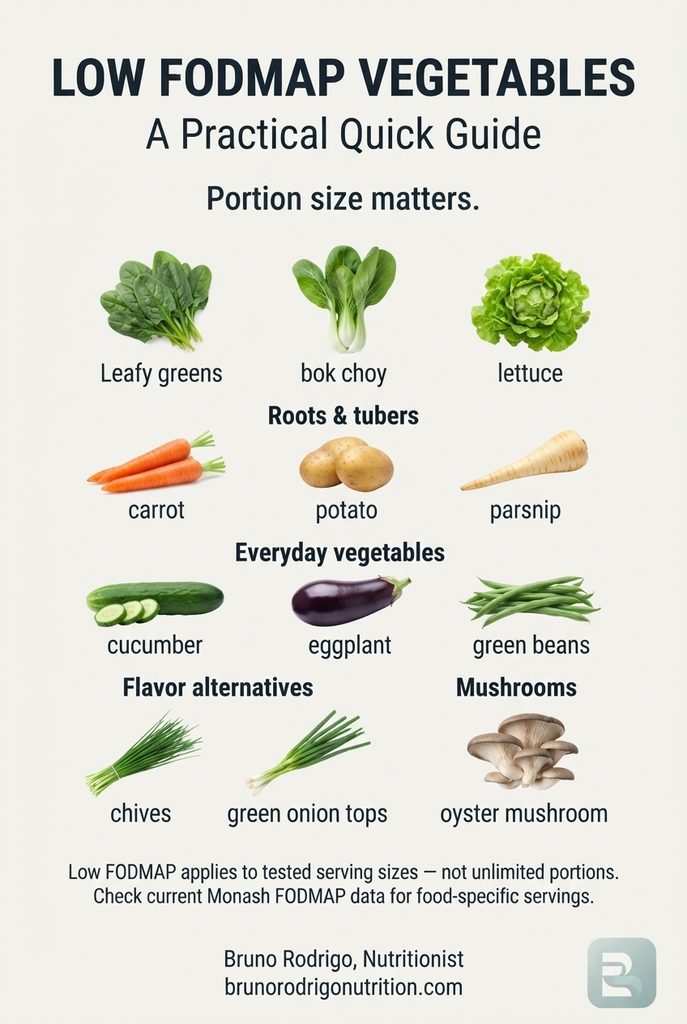
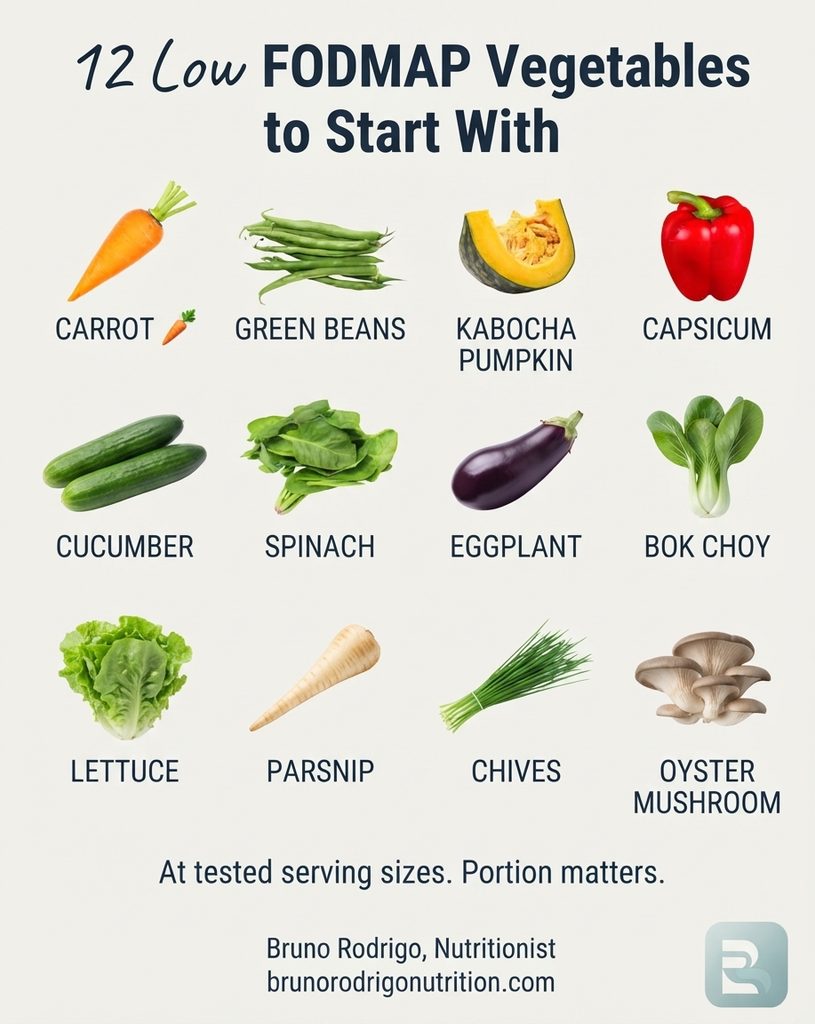
Low FODMAP vegetables are vegetables that contain relatively small amounts of fermentable carbohydrates at a specific serving size. Common options include carrots, potatoes, cucumber, eggplant, green beans, bok choy, leafy greens and other vegetables listed below.
But there is an important catch: “low FODMAP” is not always a permanent yes-or-no label. Portion size matters. A vegetable that is low FODMAP at one serving may contain moderate or high amounts at a larger serving, and laboratory testing can change over time.
Monash University therefore recommends using its FODMAP Diet App for the most current food and serving-size information. Monash also retests foods as varieties, growing conditions and food composition change. [1]
Practical rule: use lists like this one as a starting point, not as a permanent list of foods you are “allowed” or “forbidden” to eat.
Quick-reference: low FODMAP vegetable choices
A 2025 Monash University shopping guide lists the following examples as low FODMAP at one standard 75 g (2.65 oz) serving. That standard serving is a useful orientation point — not necessarily the maximum amount that remains low FODMAP for every food. Check the current Monash App for food-specific thresholds. [2]
| Type | Practical low FODMAP examples |
| Leafy vegetables | Lettuce, spinach, bok choy, red or white cabbage, collard greens, kale |
| Roots and tubers | Carrot, parsnip, potato, sweet potato, radish, yam |
| Pods | Snow peas, green beans |
| Vegetables with seeds | Eggplant, green bell pepper, cucumber, kabocha pumpkin |
| Processed vegetables | Pickled beetroot, canned tomato |
| Flower vegetables | Broccoli head |
| Seeds | Corn kernels |
| Mushrooms | Oyster mushrooms |
Important: serving sizes and classifications may change as foods are retested. Use this guide for practical orientation and consult the current Monash University FODMAP Diet App for the latest laboratory-tested serving information. Monash specifically notes that agricultural practices, geography, environmental conditions and different cultivars can affect FODMAP content. [3]
What Makes a Vegetable Low FODMAP?
FODMAP stands for fermentable oligosaccharides, disaccharides, monosaccharides and polyols. These are short-chain carbohydrates that can be poorly absorbed in the small intestine and can contribute to symptoms such as bloating, abdominal pain, gas, diarrhea or constipation in some people with irritable bowel syndrome (IBS).
You cannot reliably determine the FODMAP content of a vegetable simply by looking at it or comparing it with similar foods. Laboratory analysis is needed, which is why resources such as the Monash University FODMAP Diet App use tested foods and serving-specific traffic-light ratings. [4]
The American College of Gastroenterology recommends a limited trial of a low FODMAP diet for people with IBS to improve global symptoms. It is not intended to become an indefinite restriction diet. [5]
Low FODMAP Vegetables: A Practical List
Leafy greens
Leafy vegetables can make it much easier to maintain variety during the restrictive phase.
Examples included in Monash’s low FODMAP shopping list include:
- lettuce;
- spinach;
- bok choy;
- kale;
- collard greens;
- red cabbage;
- white cabbage.
These are useful because they can provide volume, texture, micronutrients and fiber without turning every meal into a list of special “diet foods.” [6]
The important point is still portion and individual tolerance, rather than assuming that the same amount works for everyone.
Root vegetables and tubers
Common options include:
- carrots;
- potatoes;
- parsnips;
- radishes;
- yams;
- sweet potatoes.
Carrots and potatoes are also included on Monash’s general list of low FODMAP alternatives. [7]
Some foods in this group illustrate why portion size matters particularly well. A food can have a low-FODMAP serving and then contain enough of a specific FODMAP to receive a different rating at larger amounts.
That does not make the food “bad.” It makes dose part of the classification.
Cruciferous vegetables
Cruciferous vegetables are a good example of why family names are not enough to predict FODMAP content.
Monash’s 2025 guide lists broccoli head as a low-FODMAP option at its standard serving, while cauliflower appears among the high-FODMAP vegetables in Monash’s general sample food list. [8]
So a rule such as:
“cruciferous vegetables are high FODMAP”
would be too simplistic.
Different vegetables — and sometimes different portions or parts of the same vegetable — can behave differently.
Squash and gourds
Kabocha pumpkin appears in Monash’s low-FODMAP shopping list. Zucchini also appears in Monash materials as a low-FODMAP alternative, although the serving size should be checked in the current app. [8]
This is another reason not to use broad rules such as “all squash is low FODMAP.”
Check the specific variety and serving.
Tomatoes, peppers and other fruiting vegetables
Useful options can include:
- cucumber;
- eggplant;
- green bell pepper;
- some tomato preparations and portions.
Notice the wording: some.
Monash’s 2025 shopping guide lists canned tomato at its standard low-FODMAP serving, while tomato type and serving size should still be checked individually in the app. Green bell pepper is listed as a low-FODMAP alternative in Monash resources. [8]
This category is a good illustration of why copying an old chart without specifying the variety or serving can lead to contradictory advice.
Beans, pods and sprouts
Green beans and snow peas appear among Monash’s low-FODMAP examples. Other legumes and pulses can be more complicated because their FODMAP content depends on the food, serving size and sometimes preparation or processing. [8]
So:
“Beans are high FODMAP”
is too broad.
And so is:
“Beans are low FODMAP.”
The specific food and amount matter.
Alliums and flavor alternatives
Onion and garlic are among the most common high-FODMAP vegetables because they contain fructans.
Fortunately, reducing onion and garlic does not mean food has to become flavorless.
Practical alternatives include:
- chives;
- green onion tops;
- herbs and spices;
- garlic-infused oil;
- onion-infused oil.
Garlic- and onion-infused oils can work because fructans are water-soluble but not fat-soluble. The flavor compounds can move into the oil without the same transfer of fructans that occurs into water-based preparations. [9]
This is usually much more practical than asking someone to eat bland food for weeks.
Mushrooms
“Mushrooms” should not be treated as one single FODMAP category.
Monash’s general food list places mushrooms among common higher-FODMAP vegetables, while its more specific 2025 shopping guide lists oyster mushrooms as a low-FODMAP option at the standard serving. [10]
That difference is exactly why the species matters.
Portion Size Matters More Than Most Lists Suggest
One of the biggest problems with online low FODMAP lists is that they often reduce the decision to:
food = low
or
food = high
A better model is:
food + amount = FODMAP classification
The Monash App uses different traffic-light ratings at different serving sizes because the total FODMAP load can increase as the amount eaten increases. Monash deliberately sets its green thresholds conservatively so that people can generally combine several green servings in a normal meal. [11]
That means two statements can both be true:
“This vegetable has a low-FODMAP serving.”
and:
“A larger amount of the same vegetable may not remain low FODMAP.”
This is why a serving size is more useful than a simple allowed/forbidden list.
Why Low FODMAP Vegetable Lists Sometimes Disagree
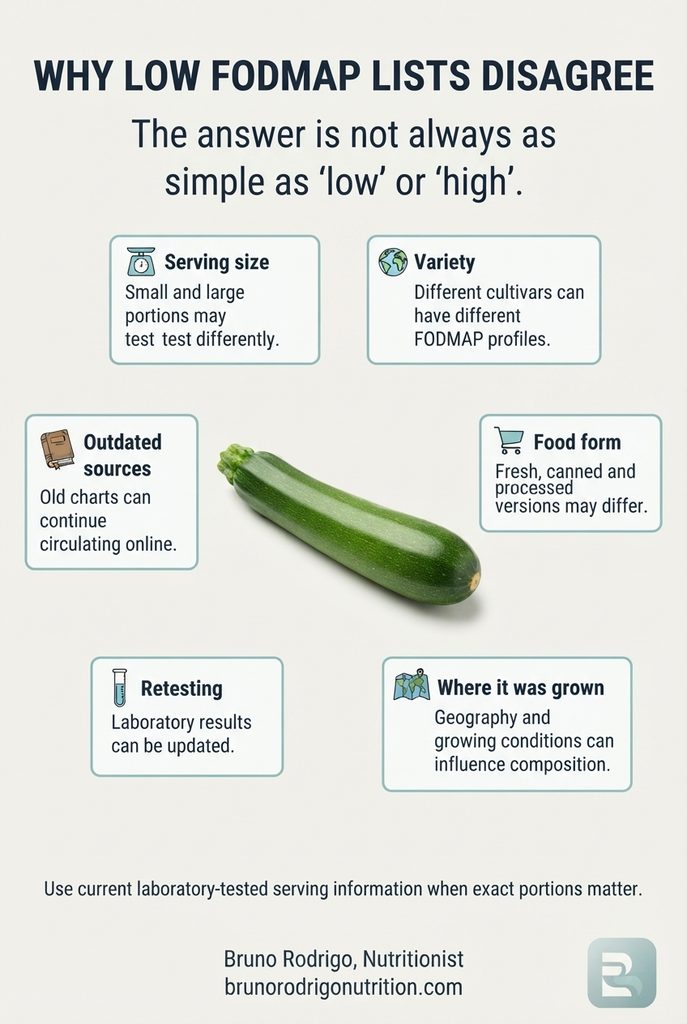
If one website says a vegetable is low FODMAP and another says it is not, that does not automatically mean one of them is lying or incompetent.
There are several legitimate reasons lists can differ.
| Why lists disagree | What it can change |
| Serving size | A small serving may be low while a larger serving is moderate or high |
| Vegetable variety | Different cultivars may have different carbohydrate profiles |
| Fresh vs canned or processed | Processing can change the composition of the food |
| Country of origin | Produce grown in different locations may test differently |
| Agricultural conditions | Climate, soil and growing conditions can influence plant composition |
| Retesting | New laboratory analysis can update older classifications |
| Old sources | Static charts may continue circulating after the underlying data change |
Monash has specifically reported meaningful variation in fresh produce between countries and over time. This has led its researchers to move away from permanently describing foods as “FODMAP free.” [12]
This is also why an article like this should not try to replace the Monash App.
The article explains how to make sense of the information.
The app provides the evolving laboratory data.
Popular Vegetables People Ask About
Are tomatoes low FODMAP?
Some tomato types and servings can fit a low FODMAP diet, but tomato should not be treated as one universal entry.
Monash’s 2025 shopping guide lists canned tomato as low at its standard serving, while its other materials recommend checking the app for current tomato serving sizes. [13]
The practical answer is therefore:
check the tomato type and portion rather than assuming all tomatoes have the same classification.
Are potatoes low FODMAP?
Yes, plain potatoes are included among Monash’s low-FODMAP vegetable alternatives. [14]
What gets added to the potato still matters. Onion, garlic, certain sauces or other ingredients can change the FODMAP profile of the overall dish.
Is broccoli low FODMAP?
Broccoli can have a low-FODMAP serving.
Monash’s 2025 shopping list specifically includes broccoli head as low at one standard serving. [16]
Avoid turning that into “all broccoli in any amount is low FODMAP.” Portion and the specific food entry still matter.
Are onions and garlic low FODMAP?
Onion and garlic are generally high in fructans and are common high-FODMAP ingredients. [15]
Chives, green onion tops and infused oils can help preserve flavor during the low-FODMAP phase. Garlic-infused oil is particularly useful because fructans do not dissolve in fat in the same way they dissolve in water.
Are mushrooms low FODMAP?
It depends on the mushroom.
Common mushrooms appear among higher-FODMAP examples on Monash’s sample list, while oyster mushrooms are listed as a low-FODMAP option in Monash’s 2025 shopping guide. [17]
Species matters.
Is zucchini low FODMAP?
Zucchini has a low-FODMAP serving and is listed by Monash as a low-FODMAP vegetable alternative. [18]
Because serving thresholds can change with updated testing, use the current app rather than relying indefinitely on a gram amount copied from an older website.
Low vs High FODMAP Vegetable Swaps
The most useful swap is usually not the vegetable that looks most similar.
It is the one that performs a similar culinary job.
| Instead of | Try | Why it can work |
| Onion | Chives or green onion tops | Adds fresh allium flavor |
| Garlic | Garlic-infused oil | Provides garlic flavor without the same fructan transfer |
| Common mushrooms | Oyster mushrooms | Similar savory/umami role |
| Cauliflower mash | Potato-based mash | Similar texture and culinary use |
| High-FODMAP vegetables in a stir-fry | Bok choy, carrot, green beans or suitable peppers | Keeps variety, texture and color |
The goal is not to create an increasingly short list of safe foods.
It is to preserve as much variety, enjoyment and nutritional adequacy as possible while controlling symptoms.
What About FODMAP Stacking?
You may have read that two or three low-FODMAP foods should never be eaten together.
That is an oversimplification.
FODMAP amounts do add up within a meal, but Monash intentionally uses conservative green serving thresholds so people can generally combine multiple green servings in one sitting.
Monash’s practical advice is particularly important:
If your symptoms are already well controlled, there is no need to start worrying excessively about stacking.
Stacking becomes more relevant when a person continues to experience symptoms despite eating foods within low-FODMAP serving sizes. [20]
In other words:
do not turn FODMAP stacking into unnecessary food mathematics.
Common Low FODMAP Vegetable Mistakes
1. Treating “low FODMAP” as unlimited
A low-FODMAP serving does not necessarily mean every larger portion remains low.
Portion matters.
2. Treating “high FODMAP” as permanently forbidden
The purpose of the diet is not to discover a permanent blacklist.
It is to identify your individual tolerance.
Foods that trigger symptoms at one amount may be tolerated at another, and tolerance can also be reassessed over time.
3. Following an old food list indefinitely
Food testing changes.
Monash actively retests foods and updates recommendations as new laboratory data become available.
Whenever an old PDF, infographic or blog disagrees with the current app, favor the updated tested information.
4. Assuming gluten-free means low FODMAP
Gluten and FODMAPs are not the same thing.
Gluten is a protein. Fructans — an important FODMAP subgroup — are carbohydrates.
Wheat foods often contain both gluten and fructans, which helps explain the confusion, but avoiding gluten does not automatically create a low-FODMAP diet. Likewise, some foods that contain gluten may still fit an individualized FODMAP diet depending on their fructan content and serving. [21]
5. Removing more vegetables than necessary
The more foods you remove “just in case,” the harder it becomes to maintain variety, adequate fiber intake and a practical diet.
Low FODMAP should generally involve substitution, not simply removing food after food.
Monash itself describes Step 1 in those terms: swap higher-FODMAP foods for lower-FODMAP alternatives.
6. Obsessing over stacking when symptoms are already controlled
You do not need to calculate the FODMAP content of every ingredient to several decimal places.
For many people, normal combinations of green servings are well tolerated.
Use additional precision when it solves a real problem — not simply because more tracking is possible.
7. Never progressing to reintroduction
This may be the most important mistake.
A successful restrictive phase is not the end of the FODMAP process.
It is the information-gathering stage that makes reintroduction possible.
What Happens After the Restriction Phase?
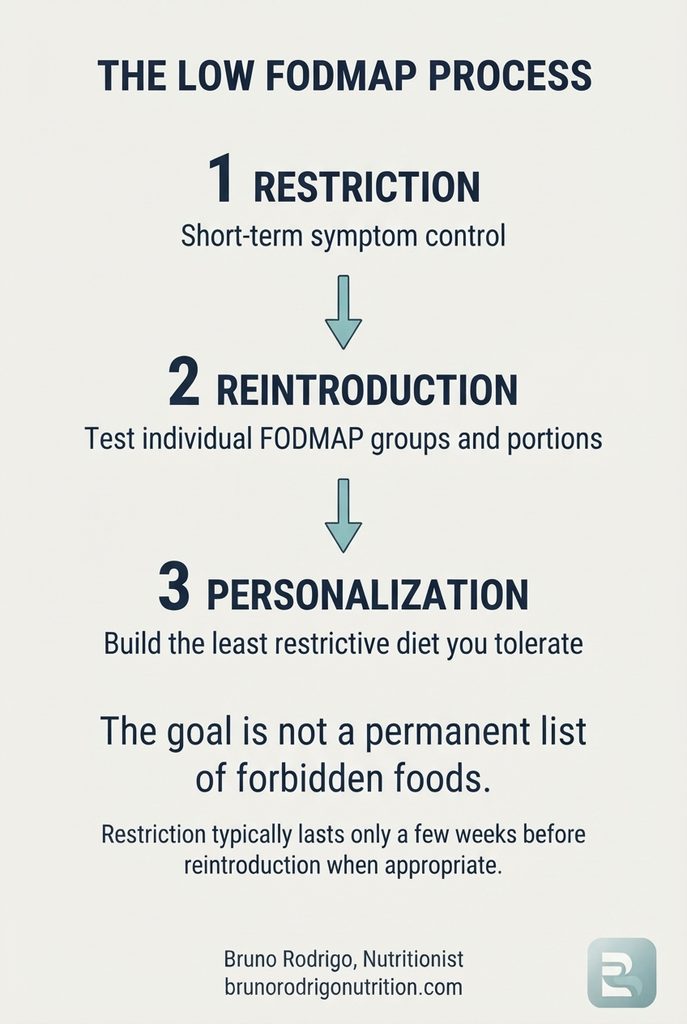
The low FODMAP approach is designed around three phases:
1. Restriction
↓
2. Reintroduction
↓
3. Personalization
Monash describes the initial low-FODMAP phase as approximately 2–6 weeks. If symptoms improve, foods and individual FODMAP groups are then systematically reintroduced to identify personal tolerances. The long-term goal is a personalized diet that includes tolerated foods while restricting only what is necessary for symptom control. [22]
The American Gastroenterological Association describes the same three-stage model and advises that restriction should last no more than about 4–6 weeks. [23]
Those ranges are not contradictory in the way that matters clinically.
Both sources make the central point clear:
the restrictive phase is temporary.
The long-term objective is not to eat from the smallest possible list.
It is to learn:
- which FODMAPs you tolerate;
- which ones trigger symptoms;
- in which amounts;
- and how much dietary flexibility you can regain.
This is where a generic food list becomes less useful and individual response becomes more important.
When to Get Professional Help
Professional guidance may be especially useful if:
- gastrointestinal symptoms remain persistent or difficult to interpret;
- you have not received an appropriate diagnosis;
- your diet keeps becoming more restrictive;
- you struggle to reintroduce foods;
- you are worried about nutritional adequacy;
- or you cannot identify clear food–symptom patterns.
The AGA also emphasizes that restrictive dietary strategies are not appropriate for every patient and that individualized nutrition care matters. [24]
A low FODMAP list can help you start.
The long-term goal is not to stay on the longest possible restriction list — it is to identify which foods and amounts you personally tolerate.
Frequently Asked Questions (FAQ)
What vegetables are low FODMAP?
Common examples include carrots, potatoes, cucumber, eggplant, green beans, bok choy and leafy greens. However, the classification applies to a serving size, not simply to the vegetable’s name. [25]
What vegetables are high FODMAP?
Common examples on Monash’s sample list include onion, garlic, asparagus, cauliflower and some mushrooms. Serving size and variety still matter. [26]
Can I eat several low FODMAP vegetables in one meal?
Generally, yes. Monash sets green serving thresholds conservatively so multiple low-FODMAP foods can usually be combined. If symptoms are well controlled, there is normally no reason to micromanage “FODMAP stacking.” [27]
Is gluten-free the same as low FODMAP?
No. Gluten is a protein, while FODMAPs are fermentable carbohydrates. Some gluten-free foods can still contain high-FODMAP ingredients, while certain foods containing gluten may contain relatively small amounts of FODMAPs depending on the product and serving. [28]
How long should I stay on a low FODMAP diet?
The strict phase is temporary. Monash recommends approximately 2–6 weeks, followed by reintroduction if symptoms improve. The final goal is an individualized, less restrictive eating pattern. [29]
Key Takeaway
The most useful question is not simply:
“Is this vegetable low FODMAP?”
It is:
“Is this vegetable low FODMAP at the amount I am eating, based on current testing — and how does it fit my individual tolerance?”
Use current laboratory-tested serving information, keep the restrictive phase temporary, and remember that reintroduction and personalization are part of the treatment — not signs that the diet failed.
Sources
- Monash University — current sample high/low FODMAP food list. Monash FODMAP food list
- Monash University — 2025 Low FODMAP Shopping List, including the 75 g standard-serving vegetable table. Monash Low FODMAP Shopping List
- Monash University — why tested FODMAP values can change. Retested Foods — Why FODMAP Content Might Change
- Monash University — FODMAP stacking. FODMAP Stacking Explained
- Monash University — the three-step FODMAP diet. Starting the Low FODMAP Diet
- Lacy et al. — ACG Clinical Guideline: Management of Irritable Bowel Syndrome. PubMed
- Chey et al. — AGA Clinical Practice Update on the Role of Diet in IBS.

Comments
One response to “Low FODMAP Vegetables: What to Eat, Portions, Swaps and Common Mistakes”
[…] Looking specifically for vegetables? → Read: Low FODMAP Vegetables: What to Eat, Portions, Swaps and Common Mistakes. […]